

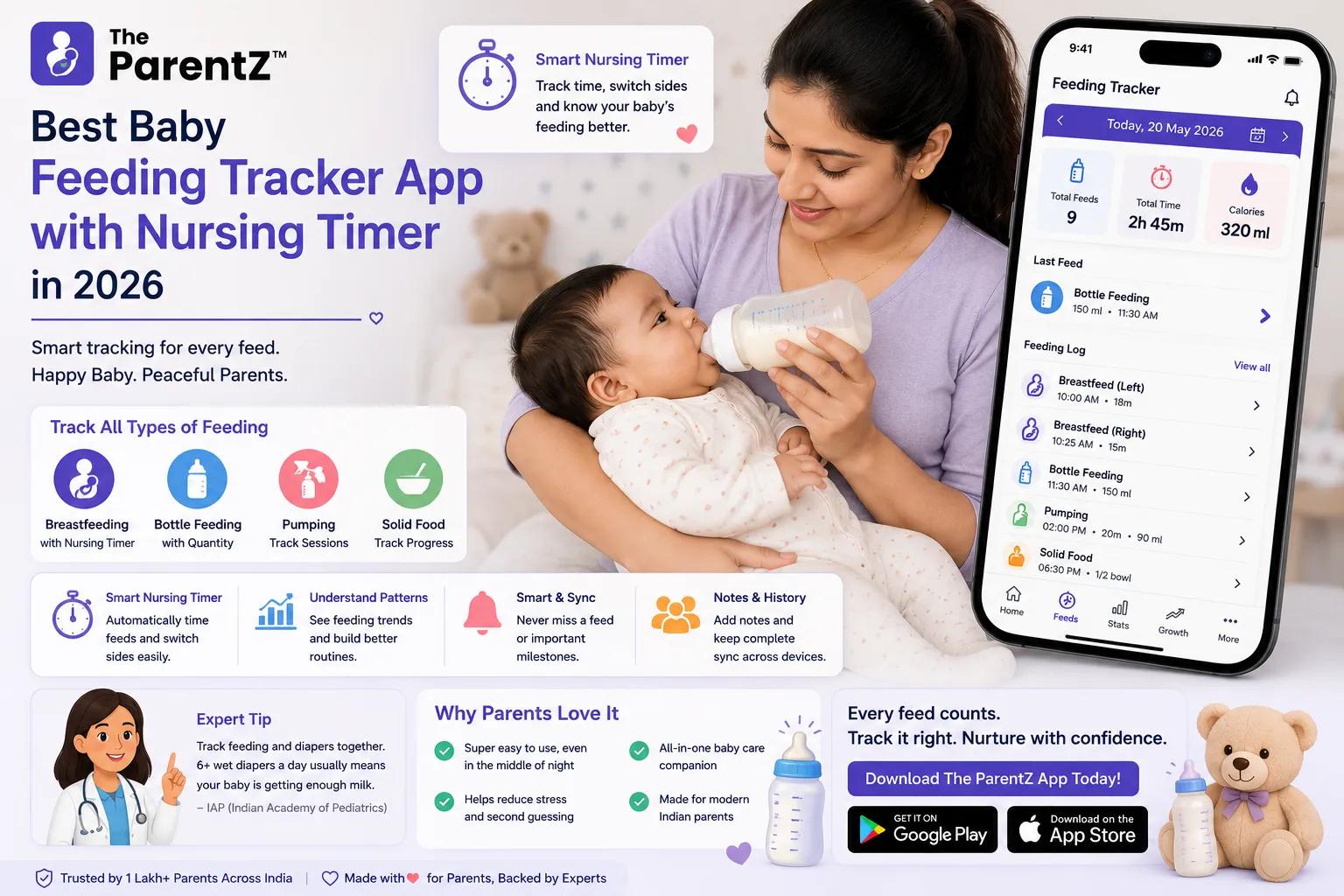
babyfeedingtrackerapp
Three weeks into new parenthood, I was keeping a feeding log on a torn notepad. Timestamps. Left or right breast. Duration. Diaper count. It looked like evidence from a crime scene.
By week five, the notepad was gone. I don't know where. And I was back to guessing.
If you're searching for the best baby feeding tracker app with a nursing timer right now, you've already figured out what I figured out too late — that trying to track feeds in your head, or on paper, while running on four broken hours of sleep is not a system. It's a wish.
The numbers back this up. The WHO recommends exclusive breastfeeding for the first 6 months, yet India's National Family Health Survey (NFHS-5) found that only around 63.7% of infants under 6 months are exclusively breastfed — and one of the biggest reasons mothers stop early is the anxiety of not knowing whether the baby is feeding enough. That anxiety is real. And a Baby feeding tracker App with nursing timer doesn't eliminate the anxiety overnight, but it gives you something better than feelings to work from — actual data.
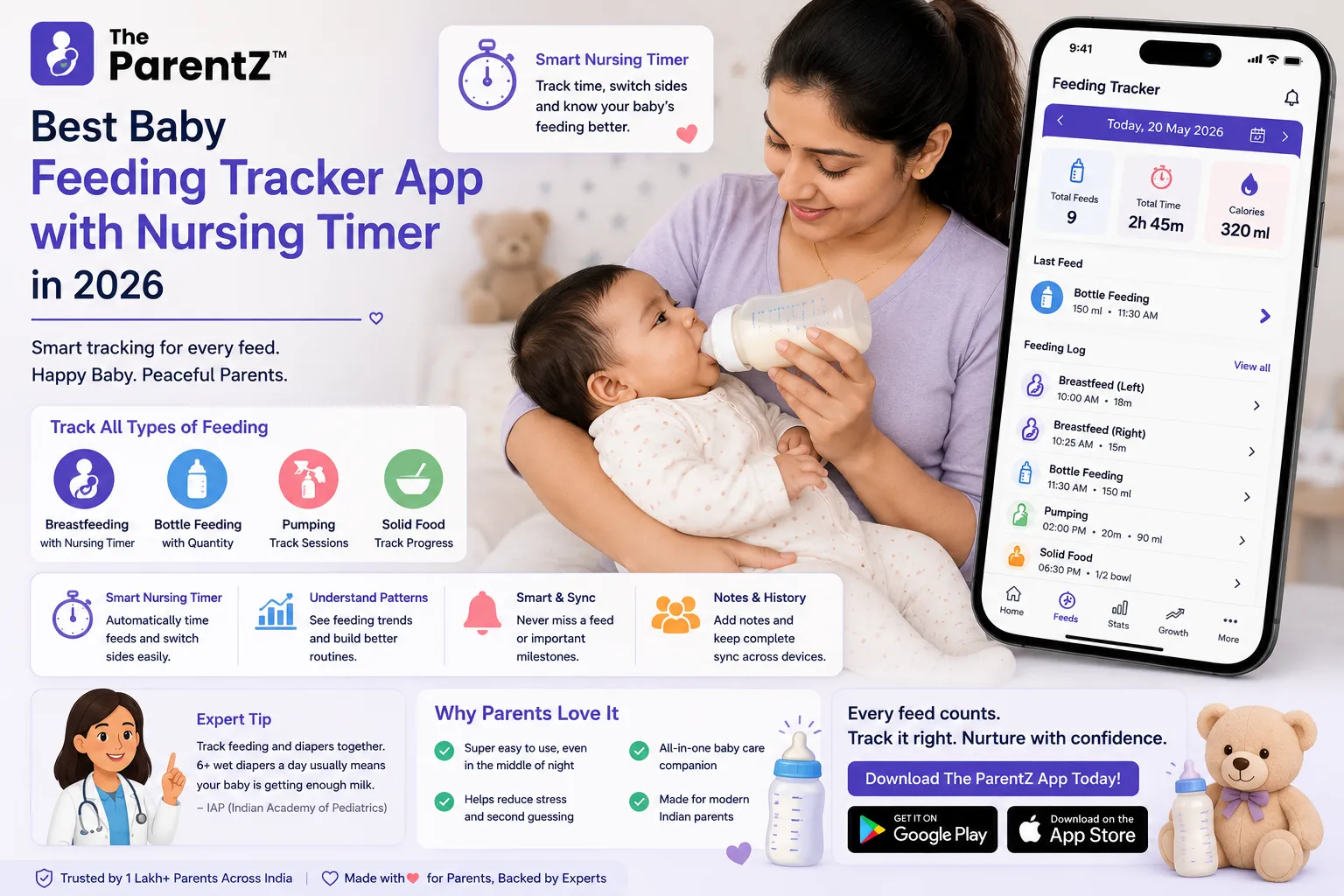
What Makes a Baby Feeding Tracker App Actually Worth Using in 2026?
The app stores are full of feeding trackers. Most of them do the basic job. The question isn't whether an app logs feeds — it's whether it's fast enough, accurate enough, and useful enough to stick with when you're exhausted.
Here's what separates a good feeding tracker from one you'll delete after two weeks:
Speed of logging. If it takes more than 20–30 seconds to log a feed, you won't do it at 3 AM. This is not negotiable.
A real nursing timer. Not a clock. An in-app timer that starts when you tap, runs in the background, and auto-logs the duration when you tap stop. Some apps call themselves "feeding trackers" but make you enter the duration manually afterward. That's not a nursing timer. That's extra homework.
Side tracking. The app needs to remember which breast you fed on last and automatically suggest the next side. Forgetting this is the most common breastfeeding mistake — and the easiest one to fix with a decent app.
Diaper logging alongside feeds. Feed count and wet diaper count together tell you whether your baby is getting enough milk. Separately, they're incomplete. A good app ties them together in one view.
Clean, readable history. After a week of logging, you should be able to glance at your feed history and immediately see the pattern — not scroll through a wall of text.
Why Indian Parents Specifically Need a Better Feeding Tracker
This isn't a generic parenting problem. In India, the feeding situation has specific pressures that most international apps weren't designed around.
The joint family dynamic
In many Indian households, the baby is with multiple caregivers throughout the day — the mother, the nani or dadi, sometimes a bai. When the mother steps away, the other caregiver needs to know when the last feed happened and how long it was. If that information lives only in the mother's memory, it's already unreliable. If it's in an app that anyone with the phone can open, it's accessible.
The formula pressure
Indian families often push formula supplementation earlier than needed — not from bad intentions, but from genuine concern that the baby isn't getting enough. A mother who has a week of feed logs showing 9–10 feeds per day and consistent wet diapers has actual evidence to push back calmly. A mother without that record is arguing from feeling against other people's opinions.
The switching-between-cities problem
Indian families move. For work, for in-laws, for the summer. When you arrive at a new pediatrician in a new city, and they ask about your feeding history, a complete log in an app is a different experience from "I think she feeds about 8 times a day, maybe less."
The Best Features to Look for in a Feeding Tracker App in 2026
Let me break these down specifically, because the feature list on app store pages is usually useless for figuring out what actually works.
Nursing timer — what good looks like vs. what's just a label
A real nursing timer: you tap "Start — Left," the timer runs on your screen while you nurse, you tap "Switch" when you move to the right breast (the app records the time on left and starts timing right), and you tap "Done" when the feed ends. The whole session is automatically logged with left duration, right duration, and total feed time.
A fake nursing timer: you open the app, you manually enter "started at 2:14 AM, ended at 2:37 AM, left breast 12 minutes, right breast 11 minutes." That's not a timer. That's a form.
The Parentz uses the real version. The timer runs. You tap. The app handles the rest.
Feed history and pattern view
After 10 days of logging, a good app should show you something like: "Average 9.2 feeds per 24 hours. Average session: 18 minutes. Most common feeding window: 10 PM – 2 AM."
That summary view is more valuable than the raw log. It tells you the story instead of making you read all the entries.
Diaper tracker integration
Log wet diapers and dirty diapers alongside feeds. The standard benchmark — from both WHO and AAP — is 6 or more wet diapers per day after day 4 as a sign of adequate intake. When you have both feed count and diaper count in the same app, you can check this yourself before the next clinic visit.
Formula and mixed feeding support
Any app worth recommending in 2026 should log formula feeds just as cleanly as breastfeeds — volume in ml, time, brand if you want it. Mixed feeding is common in India, and there's absolutely no reason the app should make it harder to track.
Solid food log starting at 6 months
When your pediatrician clears you to start solids — usually around 6 months — you want to log what was introduced, when, and how the baby responded. The best feeding tracker apps extend into this phase naturally, without you needing a separate app.
App Comparison: What's Available in 2026 and How They Stack Up
There are several feeding tracker apps that Indian parents consider. Here's an honest comparison based on what actually matters for daily use:
Feature | The Parentz | Generic International Apps | Basic Free Apps |
|---|---|---|---|
Real nursing timer (auto-log) | ✅ Yes | ⚠️ Varies | ❌ Often manual |
Side tracking + suggestion | ✅ Yes | ✅ Usually | ⚠️ Sometimes |
India-specific context | ✅ Yes | ❌ No | ❌ No |
Diaper log integrated | ✅ Yes | ✅ Usually | ⚠️ Sometimes |
Formula + mixed feed tracking | ✅ Yes | ✅ Usually | ⚠️ Limited |
Solid food log | ✅ Yes | ⚠️ Some | ❌ Rarely |
Works offline | ✅ Yes | ⚠️ Varies | ⚠️ Varies |
Growth + milestone in the same app | ✅ Yes | ❌ Separate apps | ❌ No |
Android + iPhone | ✅ Both | ✅ Usually | ⚠️ Varies |
Hindi/regional support | ✅ Yes | ❌ English only | ❌ Usually not |
The column that matters most for Indian parents is the last two — offline support and keeping everything in one app. Juggling four different apps for feeding, growth, vaccinations, and milestones is nobody's idea of a good time.
How to Set Up a Feeding Tracker App Properly From Day One
Most parents install the app, poke around for five minutes, and start using it wrong. Here's how to do it right:
Before the baby arrives (if possible): Download the app and set up your profile during the third trimester. Get familiar with the timer and the logging screen while you have the mental bandwidth. When the baby arrives at 2 AM, this is not the time to figure out the interface.
Day 1: Log the very first feed at the hospital. This creates your baseline and builds the habit immediately.
Week 1: Focus only on the nursing timer and the feed log. Don't worry about features you haven't needed yet. Just start, switch, stop, done.
Week 2: Add diaper logging. Once you have both feeds and diapers being tracked, you can check the "Is my baby getting enough?" question before the next pediatric visit.
Month 2 onwards: Look at the weekly summary. Notice if the average feeds per day is going up or down. Notice if the longest gap between feeds is getting longer (usually a good sign). Start using the data actively, not just recording it.
Month 6: When you start solids, extend your logging to include what foods were introduced and any reactions. The feeding tracker becomes your food introduction diary.
What Most Feeding Tracker Reviews Don't Tell You
I want to be honest about the things that actually trip parents up — because most "best app" reviews skip this part.
The side-switching reminder only helps if you follow it. The app can tell you "last fed: right breast" all it wants. If you ignore it because the left side feels more comfortable, the information is useless. The timer is a tool, not a rule enforcer.
Night feed logging is where habits break down. During the day, you remember. At 3 AM after a 25-minute nursing session, your brain just wants to put the baby down and go back to sleep. The fix: log it the moment you tap "stop" on the timer, before you do anything else. If you wait until morning, you'll have blanks in your record.
Formula volume logging is more useful than it feels. Most mothers who do mixed feeding log breastfeeds carefully and estimate formula volumes. Estimating defeats the point. Take the 10 seconds to enter the exact amount. Over two weeks, the pattern of how much formula is supplementing tells you whether the breastmilk supply is adequate or whether the gap is growing.
Don't log every single cluster feed as a separate session. Cluster feeding — where the baby feeds for a few minutes, pauses, feeds again, pauses — is not the same as a full feeding session. If you log every 7-minute segment separately, your feed count looks alarming (20+ feeds a day), and your duration looks too short. Log cluster feeding as one extended session. Ask your doctor what they prefer if you're unsure
Frequently Asked Questions
How many times should a newborn feed in 24 hours?
The WHO and AAP recommend 8–12 feeds per 24 hours for newborns in the first few weeks. This naturally decreases as the baby grows and takes more milk per session. A feeding tracker shows you whether you're in that range without mental math.
What if my baby feeds more than 12 times a day?
Cluster feeding periods — common in the evening, and during growth spurts — can push daily feeds above 12. This is usually normal and temporary. Log the data, note the pattern, and mention it at your next pediatric visit. Don't panic based on a number in isolation.
Can I use The Parentz for formula-only feeding?
Yes. The app logs formula feeds by volume and time, with no assumptions about breastfeeding. The nursing timer is an additional feature — you don't have to use it.
My husband/mother-in-law takes the baby for some feeds. Can they log in too?
With The Parentz, yes — shared access lets multiple caregivers log to the same profile. This is important for joint family situations where the baby has more than one primary caregiver throughout the day.
Is it worth using a feeding tracker after 6 months when solids start?
Yes, though the focus shifts. You're less concerned about nursing duration at 8 months and more interested in what foods have been introduced, how much formula or breastmilk is still being consumed, and whether the overall nutrition picture looks complete. The Parentz extends into this phase.